Confessions of a Reformed Toadie (or, The Great Toad Massacre of 1975)

Mr Toad

The fear of man lays a snare, but whoever trusts in the Lord is safe. – Proverbs 29:25 (ESV)

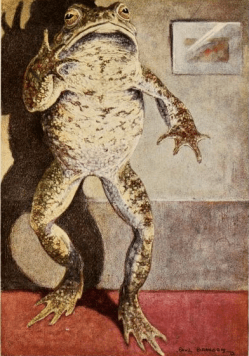
My brother and I were blessed to be raised in the country, in a little brick house with a huge yard, surrounded by woods and our grandpa’s cow pasture.  We had a red wagon and, on hot summer days, would go out in the backyard and catch toads.

“Why?” you ask.  Because we were boys.  And boys do things like catch toads.

And put them in a wagon.

A red, metal wagon.

In the summer.

In the sun.

I have never actually placed a frog in a pot of cold water and gradually turned up the heat until said amphibian cooked through without jumping from the boiling cauldron.  However, I can tell you a bunch of toads accidentally left in a red wagon in the hot, blazing sun produces the same outcome, only via a different cooking method.

And it was an accident.  We didn’t intend to harm these toads, let alone sauté them.  Like I said, we were boys.  Our attention span was evidently shorter than the time it takes to fry toads in a red wagon.

I share this story not to ruin anyone’s appetite but to illustrate a point.  When we live to please people instead of God, we end up like a toad in a little red wagon.

We find ourselves compromising what we know to be true to gain favor with others.  We base our decisions on how others might feel.  This is not to say we should ignore other’s feelings – far from it.  Rather, we cannot let the opinions of others lead our lives.  Only God should do that.

Proverbs calls the fear of man a snare – a wire loop trap designed to catch small animals by tightening around them when they step in it.  If it tightens around the throat (or too tightly around the torso), it can kill its victim.  In fact, snares are so dangerous that they are heavily regulated in much of the U.S., and banned outright throughout Europe.

Fearing man over God is a dangerous place to be.  That fear keeps us from moving forward in life, from growing as the Lord would have us grow, doing boldly what He wants us to do boldly.  Our decisions need to be based on God and His Word and seeking Him first and foremost, above all else.

In its extreme form, people pleasing leads to being a mindless “yes man”, a sycophant.  There is a name for people like this: toadies.

Simply pleasing people in order to gain their approval or favor is a mistake.  You just end up sweating in a little red wagon, slowly frying, unable – even unwilling – to jump out to the safety of the cool grass below.

Trust me, I know.  I am a reformed toadie.  It has taken a lot of years but I see that living to seek the approval of other people is a dead end.  A trap.

A snare.

For me, being a toadie took the form of wanting everybody around me to like me, to accept me, to love me.  The thought of disappointing someone else was agonizing.  It was all rooted in a poor sense of self, in considering myself to be beneath everyone I looked up to.

I could hear the sizzle.  I could smell the burn.  I just didn’t realize I was smelling myself in a hot wagon.

Then, one day, it finally dawned on me.  Where did all this attempted people pleasing get me?  Absolutely nowhere.  Love cannot be earned.  It is given freely.  And not everyone is going to love you.

But God will.  And does.  God loves me – and you – despite our foibles or mistakes. He always has.  He always will. 

5  Out of my distress I called on the Lord; the Lord answered me and set me free. 6  The Lord is on my side; I will not fear. What can man do to me? 7  The Lord is on my side as my helper; I shall look in triumph on those who hate me. 8  It is better to take refuge in the Lord than to trust in man. – Psalms 118:5-8 (ESV)

So… ask yourself this: are you more afraid of what someone else thinks or says about what you do, say or believe than you are of what God thinks?  Why are you doing what you do?  Who do you live to please?  Is it worse to disappoint a person or the Lord?  Who is the ultimate authority in your life?  And why does it matter what other people think?  Whose expectations are you trying to meet?

Generally speaking, you will never please another person who expects you to cow-tow to them.  You cannot fulfill another human beings whims so completely that they – or you – will ever find any freedom.  The toadie is a slave to people pleasing.  And the person expecting such behavior from others is a slave to ego.

Be free in Christ.  Seek God and His will first.  Is it good to seek wise counsel from others?  Of course.  Is it good to seek their approval?  No.

Do not fear the opinions of others.  Do not live to seek the approval of others.  Live a life that is pleasing to the Lord and don’t let the opinions of others be a noose.  Snare that inner toadie.  Live in Christ!  Be salt and light.

For am I now seeking the approval of man, or of God? Or am I trying to please man? If I were still trying to please man, I would not be a servant of Christ. – Galatians 1:10 (ESV)


Off the Fence

Here it is, blunt and simple.

I hate anxiety.

I hate depression.

I hate worry and doubt and the low feeling of having no worth.

There are a lot of causes for all these maladies.  Sometimes the ole brain just doesn’t pump out the serotonin as it ought (and shame on every Christian who ever immediately jumped to the conclusion that your feelings are merely the result of some sin you have committed without stopping to consider physiological and psychological factors).

The truth is, no matter the root of your anxiety or depression, God forgives your sin.  You just have to confess your sin.

But, here’s the problem… So often it isn’t others who hold us back, who remind us of our pasts, who trigger fear or anxiety or doubt within us.

As Walt Kelly’s cartoon character Pogo once famously said, “We have seen the enemy, and it is us.”

Ok… I’m a little out of context here.  Kelly was commenting on the environment.  And the Bible tells us we war not against flesh and blood for ours is a spiritual battle (Ephesians 6:12).

All the same, how often are we our own worst enemy?  We allow ourselves to entertain the thoughts that worry us instead of embracing the Truth of God’s Word.  We weigh the what if scenarios as if they carry any real mass.  We fear so much that we face when all we can see is the past, and the here and now, not the future.  And, even what we can see we perceive incompletely, inaccurately, out of focus.

I wrote the other day about the fence of legalism, a barrier that keeps us trapped in unforgiveness, unable to truly live and embrace the freedom that Christ died to give us.  But, the more I think about it, how much time do we spend sitting on that fence?

And I’m not referring to how we treat others.  We can forgive and love in the name of Jesus.  But we can’t accept that same forgiveness or ourselves.  We have difficulty embracing God’s love on our own lives.  

If that’s you, straddling that legalistic fence, constantly convicting yourself of the things the Lord has forgiven you, it’s time.

Today.

Now.

Right now.

Jump down from that fence.

Come down onto the side of grace.

Accept once and for all that you are forgiven, you are loved, you are worthy of Jesus’ sacrifice.

Not because of anything you have done, but because God truly, honestly, really and fully loves you.  You are His child.

Today is the day to accept that fact.  Today, quit listening to what / who the world says you are.  Stop listening to the self condemning voice telling you your worth is diminished.

God Himself came down here and died for you.  Yes, you.  It is that personal.  It is that real.

And Jesus was no fence rider.  He spoke in absolutes.  

And He spoke against legalism.

And legalism is bad whether it comes from others, or from ourselves.

Today, take God at His Word.  Today, get off the fence and bask in the joyous glory of freedom in Christ.

Go.

Do.

Believe.

Embrace.

Love.

The Fence of Legalism

I have some bad news.

And I have some good news.

Let’s get the bad news out of the way first.  You can do nothing – absolutely nothing – to earn salvation, forgiveness or God’s love.  Your fate is entirely in the hands of God Almighty.

Now… here is the good news.  You can do nothing – absolutely nothing – to earn salvation, forgiveness or God’s love.  Your fate is entirely in the hands of God Almighty.

Yes, they are one and the same thing.  How can the exact same circumstance be both bad and good?  It’s all according to which side of the fence you are on.

When Jesus Christ walked on this earth, there were two groups of religious leaders He stood up against: the Pharisees and the Sadducees.  Both were legalistic sects of Judaism.  The Sadducees were the rich rulers of Jerusalem.  They believed in strict adherence to the Pentateuch. But they did not believe in an afterlife (or any other sort of spiritual life for that matter – which is what made the Sadducees sad, you see…)

The Pharisees were not quite wealthy, and accepted life after death and spiritual matters with no qualms.  However, they too fully equated their own rules and laws with those of God.  Both sides were quite full of themselves, sure that they were the ones who had a lock on God – that they were the only ones who not only were right, but had the right to say who and what was right.

The Pharisees believed salvation came through strict adherence to the law, as they saw it (including the additions they made, which were originally intended to make one holier).  The problem was that, in the end, the legalism led them (and their followers) away from the truth about God.

When one is filled with legalism, faith becomes difficult, as does any sense of forgiveness or mercy or kindness or love.  This is why I have such a problem with legalistic Christianity.  I believe a lot of people suffer from depression, anxiety, etc… because they have no real mechanism for processing God’s forgiveness, and love.  They have no means of honest identity with Jesus Christ.

In John 15 (ESV), Jesus tells us what it means to be a Christian, and who we are in Him:

1 “I am the true vine, and my Father is the vinedresser.”

Notice that Jesus is referring to “mou patēr” – my literal, personal Father.  God is not merely some abstract, legalistic deity. The Lord is so personal that, in Romans 8:15, we read, “For you did not receive the spirit of slavery to fall back into fear, but you have received the Spirit of adoption as sons, by whom we cry, ‘Abba! Father!’”  “Abba” is an endearing, loving, personal word for Father, perhaps better translated as “Daddy”.

2  Every branch in me that does not bear fruit he takes away, and every branch that does bear fruit he prunes, that it may bear more fruit.

The later example of Sadducees illustrates this point clearly.  Jesus was crucified around 33AD.  Less than forty years later, the Jewish Temple was destroyed by the Romans.  The Jews scattered, thus beginning the Diaspora.  The Pharisees continued, but the Sadducee sect of Judaism disappeared with the temple.  Taken away.

3 Already you are clean because of the word that I have spoken to you.

This statement flies right in the face of legalism.  Your good works cannot save you.  Only God can do that!

4  Abide in me, and I in you. As the branch cannot bear fruit by itself, unless it abides in the vine, neither can you, unless you abide in me. 5 I am the vine; you are the branches. Whoever abides in me and I in him, he it is that bears much fruit, for apart from me you can do nothing. 6 If anyone does not abide in me he is thrown away like a branch and withers; and the branches are gathered, thrown into the fire, and burned. 7 If you abide in me, and my words abide in you, ask whatever you wish, and it will be done for you.

The Pharisees and Sadducees dwelt in the Temple.  But, Jesus is pointing out that we – the believers in Christ – are the true temple.  He abides in us, and we in Him!  Remember, the Holy Spirit lives within you.  (Okay… technically that didn’t happen until Pentecost, but you know what I mean…)

8  By this my Father is glorified, that you bear much fruit and so prove to be my disciples.

Legalism brings God no glory.  All it does is impose rules and regs on people.  Faith cannot be forced.  True faith is rooted in love, and trust, and hope.  Legalism destroys all of those things.

9  As the Father has loved me, so have I loved you. Abide in my love. 10  If you keep my commandments, you will abide in my love, just as I have kept my Father’s commandments and abide in his love. 11 These things I have spoken to you, that my joy may be in you, and that your joy may be full.

I point all of this out for one reason: don’t let legalism get ahold of you.  Understand that, if you asked the Lord to forgive you, He has forgiven you.  It’s done.  You are clean not because of what you’ve done (or not done), but because of Jesus Christ.

Abide in the love of Jesus Christ.  Stop beating yourself up.  Believe you are forgiven, because you are.  Believe you are loved, because you are.  Believe the Lord is with you always – within you always – because He is.

9 You, however, are not in the flesh but in the Spirit, if in fact the Spirit of God dwells in you. Anyone who does not have the Spirit of Christ does not belong to him. 10 But if Christ is in you, although the body is dead because of sin, the Spirit is life because of righteousness. 11 If the Spirit of him who raised Jesus from the dead dwells in you, he who raised Christ Jesus from the dead will also give life to your mortal bodies through his Spirit who dwells in you. – Romans 8:9-11 (ESV)

The results are not your responsibility.  Nor are we called to figure it all out.  Just trust.  Just believe in Him.  Take Christ at His Word: undiluted, unpolluted.

Have you asked God to forgive your sin?  Have you truly accepted that Jesus as your Savior?  The understand this: the old you is gone.  Dead.  Who you were is no longer who you are.  You are now under new management.  You are no longer a slave to sin but a friend to the Lord.  You have hope.  You have no worries.  You have a new focus on loving others through Jesus Christ.

You are a new you.  Free.  Beloved.  Saved.

Revel in that.

Abide in God’s love.

Be salt and light.

Be who God created you to be.


In Stillness…

048

10  “Be still, and know that I am God. I will be exalted among the nations, I will be exalted in the earth!” 11  The Lord of hosts is with us; the God of Jacob is our fortress. Selah

Psalms 46:10-11 (ESV)

Tension.  That’s the first feeling we have when anxiety strikes.  We feel the stiff grip of tension throughout our bodies.

And our minds begin racing.  Not with any real destination in mind.  Just ’round and ’round, taking the turns at breakneck speed up on two wheels, careening out of control.

Think Indy 500 on steroids.

When anxiety strikes, the ability for rational thought is, at best, hindered (if not somewhat incapacitated).  Our peace is shattered.  Our focus is skewed.  Our hearts and minds are racing.

Look out for the third turn.

When God instructs us to “be still”, He is telling us – very pointedly – to chill out.  The root of the Hebrew word for “still” (rāpâ) means “to slacken” (Strong’s H7503).  Loosen up your grip.  Calm your mind.  Relax your body.  Release the tension.

How?  “Know that I am God,” He said.  Know that He is in control.  Know that He is all-powerful, all-knowing, ever-present.  Know that He is immovable, and He is your fortress.

In other words, have faith.  Understand that we can trust God and His Word far more than we can trust our own personal notions.  This is especially true when we are in an emotional spiral.  In moments of anxiety, rational thought tends to fly right out the window.

But we always have the Lord and His promises.  Despite what we see, He will never leave or abandon us (Hebrews 13:5).  He is our shield of protection (Psalm 3:3 and 28:7).  He is our place of safety (Psalm 91).  God is love (1 John 4:8) and nothing – nothing – will ever separate us from His love (Romans 8:35-39).

You see, the reality of our loving God means we can set aside all that worries us, all that we fear.  Peter put it this way:

6  Humble yourselves, therefore, under the mighty hand of God so that at the proper time he may exalt you, 7  casting all your anxieties on him, because he cares for you. 8  Be sober-minded; be watchful. Your adversary the devil prowls around like a roaring lion, seeking someone to devour. 9  Resist him, firm in your faith, knowing that the same kinds of suffering are being experienced by your brotherhood throughout the world.

1 Peter 5:6-9 (ESV)

Do you want to get rid of the anxiety that plagues you?  It requires a change of heart and mind, a firm decision to be led by faith and not sight.

  1. Humble yourself under God.  You are not the one in control.  That is way above our pay grade.  Not only that, our enemy is in no more control than we.  He “prowls around” as if he were “a roaring lion”.  He is a defeated foe.  His reign has an expiration date, unlike God’s eternal kingdom. It requires humility on our part to realize that God’s Word is real and true, even when it stands in opposition to what we see and perceive with our physical senses.
  2. Cast all your anxieties on God.  Peter was a fisherman.  He understood all too well the importance of a good cast.  When you cast a net – or, in more modern fishing terms, a fishing line – you aim at your target and you throw.  You have to trust that your line will go where you aimed it.  Take all of your worries, fear and doubts, humbly trusting the Lord and taking Him at His Word, and cast them off, sending them straight to God.  And leave them there.
  3. Be sober minded and vigilant.  Don’t fall for the temptation to reel those cares back in.  It may seem that the Lord isn’t working fast enough.  Maybe you doubt that He heard you at all.  Don’t go there.  Have faith.  Seek the Lord.  Be mindful that the enemy is going to try to tempt you back into anxious thoughts.
  4. Resist the enemy.  All he can do is tempt you. Be aware: he can sound very reasonable and sensible.  He can twist any fears we have and make them seem right.  But remember: He is not in control.  God is. Rest in that knowledge.
  5. You are not alone.  Never think that you are facing something unique.  God is always with you. You are not facing life alone.  One of the wonderful things about our Lord is that, not only does He guide us in the way to go, He makes the way for us.  He strengthens us.  He leads us.  He enables us to do His will.

Let today be the day.  No more anxiety.  No more worry.  Stay in God’s Word and connected in prayer.  When the opportunity for anxiety strikes again (and it will), be ready.  Stand firm on promises of God, on the firm foundation He has given you.

Be humble under God.

Be confident in His strength and love.

Be firm in your faith.

He is with you.  Always.


Changing Tenses

9 Or do you not know that the unrighteous will not inherit the kingdom of God? Do not be deceived: neither the sexually immoral, nor idolaters, nor adulterers, nor men who practice homosexuality, 10 nor thieves, nor the greedy, nor drunkards, nor revilers, nor swindlers will inherit the kingdom of God. 11 And such were some of you. But you were washed, you were sanctified, you were justified in the name of the Lord Jesus Christ and by the Spirit of our God. – 1 Corinthians 6:9-11 (ESV)

Why do we as human beings resist change so much?  We get comfortable.  We get used to the status quo.  We get cozy in our rut.

Change is inevitable.  It is an integral part of life.  You see, God created life to be active – ever changing, ever growing.  He Himself never changes (which is a good thing since He is perfect and He is, after all, God).  

Change is good.  Even painful changes are good changes because every change, at a bare minimum, offers the opportunity to grow, to mature, to learn, to reach out and help others on their journey of life.

The greatest changes are the ones that draw us closer to the Lord.  We are imperfect.  We are sinful.  We are human.

But, take a look at the passage above from 1 Corinthians.  Verses 9 and 10 stand as a warning.  But notice verse 11.  The tense changes.  No longer are we defined by what we did or who we were.  That junk is in the past.

Gone.

Done.

Dealt with.

Buried.

Forgiven. 

Cleansed.

Changed.

You are changed.

The minute you said with your heart, “Yes Jesus.  I will follow you.  Please forgive my sins and change me”, your sins were forgiven – your record expunged – and God began the process of changing you.

So today, if you find yourself struggling with your past or some sin or anything at all, embrace the Lord.  Seek Him first.  Follow His will and His Word.  Embrace the changes the Lord places before you, knowing He is with you, growing you, loving you.

The Second Day

  
So much is written about the Last Supper of Maundy Thursday, the horrors of Good Friday, and the victorious joy of Easter Sunday… Yet Scripture tells us so little about the Saturday of that momentous weekend, when the Son of God Himself was illegally tried, brutally tortured and executed, only to rise gloriously from His tomb on the third day, fulfilling the messianic promises of the Scriptures.

I try to imagine what Jesus’ disciples were doing that day. What was going through their minds?

The second day was the Sabbath, but I cannot imagine these guys went to temple that day.  They were no doubt in fear of the Jewish leaders.  Fear for their very lives.  And, besides, the temple was in need of some repairs that particular Sabbath.

I wonder if the words of Jesus, the lessons of three years of following the Lord, were ringing in their ears.  I wonder if Peter could get the sound of that rooster crowing out of his head.  Maybe he heard the Lord’s voice saying, “Get thee behind me, Satan”.

Things had happened so fast.  It hadn’t even been 48 hours since they had sat down for one last meal with Jesus (and a very significant Passover meal at that).  He had taught them so much over the years.  But the conversation this night was different.  More pointed.  More direct.  In a sense surreal.  Jesus was here to overthrow the status quo in Israel and set up a new kingdom.  Right?

And now, here He was. 

Dead.The King of Kings and Lord of Lords seemingly defeated.

The One Who had turned water into wine.  

Healed the sick.  

Regenerated the lame.  

Gave sight to the blind.  

Fed tens of thousands with one child’s small meal.  

Calmed the raging storm.  

Walked on water.  

Escaped the authorities time and again.  

Raised Lazarus from the dead after his body had begun to decompose.  

And, just the night before, put a guy’s ear back on.  Not just any guy, but the servant of one of the Roman soldiers sent to arrest Him in the garden.  This after Peter, in one his impetuous and well meaning yet – let’s call it what it was, dumb – acts, drew his sword and lobbed off this slave’s ear in an attempt to save Jesus from a fate He Himself had willingly chosen.

So many miracles.  So much promise.  And yet, here they were.

The Lord was gone.  

They couldn’t see the glory that was a few short hours away.  They couldn’t fathom the open tomb, the folded grave cloth, the retuning Jesus, the baptism of the Holy Spirit.

The disciples had experienced so much unbelievable horror in less than 24 hours.  We know Thomas temporarily lost his faith.  What about the others?  How could all of this have happened?  Had Jesus been a fraud?  Had He been out of his mind?  

 Faith is a curious thing.  “Now faith is the assurance of things hoped for, the conviction of things not seen” (Hebrews 11:1, ESV).  As humans, we base reality on the sensible, the tangible.  We want evidence.  We need proof.  

But the truth of the matter is that God defines reality.  He is the author of Truth.  We believe because the Lord said to.  We trust because God, in His infinite grace and love, mercy and power, shows us enough to see He is real and trustworthy, if only we would look with eyes of faith.

On the second day, everything looked hopeless to the disciples.  Especially for Judas Iscariot, who came to the realization of what he had done, Who he had done it to, and the impact of his greedy actions.  (When the New Testament mentions another Judas, the words “not Iscariot” follow his name, so deep was the disgust associated with the name of Christ’s betrayer).

Without faith, the third day is stripped of all significance.  The hope for the risen Christ is the only hope the disciples had on the second day.
Perhaps that hope still lingered deep within them.  

The second day was history’s most apparently hopeless yet actually hopeful day.  All the disciples could see was the unbelievable horror.  But that isn’t where the story ended.  Jesus overcame the unimaginable.  

He overcame death.  

He came back.

And He will again.  Just as He promised.

There is no dark too dark for the Lord.  There is no circumstance that is insurmountable for God.  What our limited minds perceive is not ultimate reality.  

God foretold all of this in the Old Testament.  Jesus told the disciples what was going to happen. But they couldn’t understand it.  They were blinded by their preconceived notions.  Despite all they had seen Jesus do and heard Him proclaim, they still struggled with the truth of the situation.

The ways of the Lord are so far above us that we have to take Him on faith.  We couldn’t accept His fullness if we tried.  We are simply incapable of fully understanding God and His ways.

So have faith in the Lord.  Trust in His Word.  He has given us evidence aplenty that He is Who He is, and He will do what He says He will do, and we are His beloved children.

Accept that.

Bask in that.

Let it soak into your soul.

Praise God!

And have a blessed Easter.

Small Dumplings

China 20080626 (96)For who is God, but the Lord? And who is a rock, except our God? – Psalms 18:31 (ESV)

On the scale of natural disasters, this was extremely small potatoes.  Well… not potatoes.  This happened somewhere along a highway between Dongguan and Guangzhou in southeast China, so we’ll say it was small dumplings.

We had just visited Austin’s orphanage and were heading back to our hotel in Guangzhou.  It had been rainy, steamy… the kind of humidity that makes people in Georgia in the middle of summer say, “Now that’s humid!”

There were eleven of us in the van.  We had just discovered what life had been like for our children.

We had just discovered that a Big Mac in China tastes exactly like a Big Mac in America.

And now, as we sat on a bridge overlooking the Pearl River Delta opening into the Pacific Ocean (or what we could see of it through the thick, murky haze), we were discovering the nuisance of a mudslide flowing over a busy highway.

When we finally made it to the spot where the hillside had slipped into the right lane of the road, it didn’t look like much.  But it sure slowed things down and, no doubt, was a hassle for people trying to get back to Guangzhou.

Mudslides occur when unsettled earth is eroded away by water, causing the resulting mud to shift.  Small mudslides can be a pain.  Large ones can be catastrophic.  (Yes, I’m sure I picked this information up in third grade science.)

Especially if your home is built atop the hill that just crumbled beneath it.

This week, I found some sand under my foundation – a stress trigger that I didn’t expect.  In the grand scheme of things, it is small dumplings: a non-problem that kicked my anxiety into low gear.  Not fun, but not catastrophic.  Just a spot that needs to be shored up.

The Lord is using this incident to remind me of sitting in that muggy van in China, wanting to get back to the White Swan Hotel but stuck in traffic brought to a stand-still by circumstances beyond my control.

Anytime I build my hopes, or beliefs, or plans on anything other than God, I risk the danger of a faulty foundation build on crumbling sand.  I set myself up for a mudslide.

But, when I build my hopes and beliefs on God through Jesus Christ, my Rock, I can stand firm knowing that He is the One Who controls the outcomes.

Who upholds me and guides me.

Who calls the shots.

Who knows far better than I what I need.

I do not have to be perfect.  I don’t even have to be right.  I just have to be His.

I have to yield to God.

I have to rest faithfully in Him, because when I trust in the Lord, I put down my preconceived notions and schemes and fully rely on God.

I am firmly in God’s hands.  You are, too.  And, because of that, all our problems are small dumplings.


Risk Assessment


23 And when he got into the boat, his disciples followed him. 24 And behold, there arose a great storm on the sea, so that the boat was being swamped by the waves; but he was asleep. 25 And they went and woke him, saying, “Save us, Lord; we are perishing.” 26 And he said to them, “Why are you afraid, O you of little faith?” Then he rose and rebuked the winds and the sea, and there was a great calm. 27 And the men marveled, saying, “What sort of man is this, that even winds and sea obey him?” – Matthew 8:23-27 (ESV)

It’s probably a good thing that I’m not an insurance risk assesor.  I would be paranoid of everything.  I’d never want to leave the house unless I knew I was driving the safest car on the safest roadways, going to safest places to shop, making sure my son plays only safe sports (I wonder what the chances are of injury in the school stamp club… I supposed he could get a nasty paper cut or something…)…

I would want to weigh out the possibilities of getting hurt before doing anything.  I would never step out and risk anything.  I play it too safe the way it is!

The problem is this: life isn’t safe.  Things happen.  The unexpected strikes.  Life isn’t always predictable.

Or controllable.

Or safe.

At least not by our standards.

Consider the disciples.  There were some fishermen among the twelve.  These men knew the Galilean Sea.  They had surely been caught in storms before, so this one must have been a whopper.

They looked at the storm.  They saw the raging seas, the white caps and waves, the lightning streaking across the skies.  

Everyone is freaked out.

Well… almost everyone.

Jesus is there.  Asleep.  The boat is taking on water, and the Lord is grabbing forty winks.

“Save us!” The disciples are beyond freaked out.  Even though they are perfectly safe in the midst of the maelstrom, they only see peril.

Remember, Jesus led them into the boat.  He knew a big storm was brewing.  And He led His followers straight into it.

And, because of a lack of faith – because they were terrified of a situation that was beyond their control and threatened their very lives – they seem to have forgotten just exactly Who was sleeping through it, peacefully.

And Jesus rebuked the storm.  And all was calm.

Sometimes we need to set aside trying to be a risk assesor.  Following Jesus isn’t always “safe” or comfortable.  In fact, God seems to have a way of keeping us out of our comfort zones and making us rely on Him – and realize that He is always faithful.

Despite storms.

Despite circumstances.

No matter how hard the winds howl or the storm pummels us, Jesusis always right there in the boat with those who follow Him.  Embrace His peace.  Rest faithfully in the Lord.  Cast off your cares and worries and know that the storm won’t last forever.  And when the sun breaks through the clouds, you may just see a rainbow.

May I See Your ID Please?

1  Now on the first day of the week Mary Magdalene came to the tomb early, while it was still dark, and saw that the stone had been taken away from the tomb. 2 So she ran and went to Simon Peter and the other disciple, the one whom Jesus loved, and said to them, “They have taken the Lord out of the tomb, and we do not know where they have laid him.” 3  So Peter went out with the other disciple, and they were going toward the tomb. 4 Both of them were running together, but the other disciple outran Peter and reached the tomb first. 5 And stooping to look in, he saw the linen cloths lying there, but he did not go in. 6 Then Simon Peter came, following him, and went into the tomb. He saw the linen cloths lying there, 7 and the face cloth, which had been on Jesus’ head, not lying with the linen cloths but folded up in a place by itself. 8 Then the other disciple, who had reached the tomb first, also went in, and he saw and believed; 9 for as yet they did not understand the Scripture, that he must rise from the dead. – John 20:1-9 (ESV)

There is a quality about John’s writings that are unique.  Not that the other New Testament writers churned out cookie cutter letters and testimonies.  Each is unique and special in it’s own way.

But John…

There is a humility about John, a quality of identity that comes through loud and clear in his gospel.  When John penned his gospel, he was most likely an old man.  He had been traveling his path for decades.  And the road of a first century Christian was not easy.

This was a time of political instability.  During John’s lifetime, there reigned no less than eleven (and perhaps as many as thirteen) Roman emperors, each with his own view of how to deal with Christians and Jews.  Some were indifferent, considering Christians to be some crazy little sect of Judaism.  Others were downright hostile (such as Nero, who used Christians as scapegoats for the burning of Rome, having their heads stuck on poles and lit as lanterns to illuminate the streets).  It was toward the end of Nero’s reign that Peter and Paul were both put to death.

During John’s time, walking around proclaiming the Gospel of Jesus Christ was a punishable offense in the eye of the Roman authorities.  They did not take kindly to anyone proclaiming the message of anyone about the current Caesar, revering their emperors as gods themselves.

Despite the odds, despite the hardships and the harshness of life, despite all the pain and difficulties John faced in his walk of faith, here he is: an old man of great humility.  He’s not bitter.  He’s not angry about how things have turned out.  He’s loving.

He’s humble.

John is so humble that he refuses to refer to himself in the first person.  When you see a reference to anyone named John in the fourth gospel, it is John the Baptist being mentioned, not John the Apostle.  In fact, John identifies himself as “the other disciple” and, most importantly, “the one whom Jesus loved.”

This is not a statement of superiority over the other apostles.  One can read John 20:1-10 and believe John is gloating a bit, as if he is saying, “I am the one Jesus loved.  And I beat Peter in the foot race to the tomb and got the first peak inside.”

Actually, John is merely recording the facts, correctly and honestly.  He is giving detailed testimony to the resurrection of Jesus Christ, the most important event in all human history.  He was an eyewitness.  And he is telling us in detail what happened.

Humility is vital on many levels.  For one, humility begets honesty.  John makes sure we understand that, although he arrived first to the tomb, it was Peter who was bold enough to go into the tomb.  This from the man who mere hours ago was cowering in fear, trying to blend into the crowd and disavowing any association with Jesus Christ.  John, through his humble honesty, helps us see Peter’s humanity during a time of great stress and confusion.  We get to see the hope that propelled this broken fisherman to run into the tomb and see that Jesus had done the impossible: raised from the dead.

Humility also brings strength.  When we are humble, we are more able to understand our identity in Christ.  John knew his.  He was the one whom Jesus loved.  He was no longer John the Fisherman, or John the Apostle.  His identity was fully formed in the statement “the one who Jesus loved.”  John recognizes that he has lived this long life because it was the Lord’s will:

20 Peter turned and saw the disciple whom Jesus loved following them, the one who had been reclining at table close to him and had said, “Lord, who is it that is going to betray you?” 21 When Peter saw him, he said to Jesus, “Lord, what about this man?” 22 Jesus said to him, “If it is my will that he remain until I come, what is that to you? You follow me!” 23 So the saying spread abroad among the brothers that this disciple was not to die; yet Jesus did not say to him that he was not to die, but, “If it is my will that he remain until I come, what is that to you?” 24 This is the disciple who is bearing witness about these things, and who has written these things, and we know that his testimony is true. John 21:20-24 (ESV)

Humility boldly sets the record straight.  It frames our view of reality because, when we take our eyes off of ourselves, we can better see the reality of God.  Humility opens our eyes and hearts to the fact that “(we) are not (our) own, for (we) were bought with a price” (1 Corinthians 6:19b-20, ESV).  If we recline at a feast next to Jesus Christ, it is not because any of us is any great shakes.  We did not – cannot – earn such honor, for without Christ, we have no honor.  We are sinful.  We are lost. We cannot save ourselves.

But Jesus saves us.  He changes us.  He makes us righteous.  He prepares a place for us in heaven, even though we don’t deserve us.  He loves us.  He cares for us.  He makes us His own.

And John so humbly knew it.

But, here is the thing.  The apostle John does not own the sole right to be “the disciple whom Jesus loved.”  If that were true, his gospel would be nothing more than an opportunity to brag.  John is giving his testimony that we may see the Truth, that each of us is the one whom Jesus loves.  John is shining a bright light on our Hope, our Peace.  He shows us that Jesus is God, and God loves us – always has, always will.  We are His.

When we get tied up in self – whether through worry or doubt or self-delusion or exaltation – we can’t see the Truth.  We can’t identify who we really are.  But when we realize our identity is not based on our performance or how others view us or anything we may think about ourselves… when we see our identity is in The One Who created us, Who loves us and provides for us a way out of our predicament… then we can humbly set our “self” aside and see that we are who Christ says we are.  We are His.

We are His.

Soak in that for awhile.


Tough Jobs. I Mean Really Tough Jobs…

4  Such is the confidence that we have through Christ toward God. 5  Not that we are sufficient in ourselves to claim anything as coming from us, but our sufficiency is from God, 6 who has made us competent to be ministers of a new covenant, not of the letter but of the Spirit. For the letter kills, but the Spirit gives life. – 2 Corinthians 3:4-6 (ESV)

There are some tough, grueling, dangerous jobs out there.  Underground miners.  Seafaring commercial fishermen.  Space-bound astronauts who sit atop a huge seething rocket waiting to be blasted out of the atmosphere, only to return through the fiery blaze of re-entry. Police officers and firemen, who face danger every day.  Construction workers perched on an I-beam far above the not-so-soft concrete below.  Utility linemen, strapped to a wooden pole, dealing with high voltage electricity.  (I can still remember, as a child, seeing my Uncle Larry – a telephone lineman – at the top of a utility pole, waving down at us, not fearing the fact that he was about 40 feet above us with no net underneath). Democratic presidential candidates on Fox News.

In Old Testament times, it would not have been unreasonable to place “prophet” on this list.  Many died for what they believed and proclaimed.  According to tradition, Isaiah was sawn in half.  Jeremiah faced stoning.  Ezekiel, Micah and Amos were martyred.

And work was no easier for the apostles of Jesus Christ.  In fact, their mortality was amazingly high.  The probability of being killed in the line of work for these men was at least 8 out of 11 (not counting Judas Iscariot for obvious reasons).  That’s roughly a 73% probability that you would not live to retire and draw on your 401(k).

James (the brother of John) was put to death by Herod Agrippa.

Tradition holds that Thomas was stabbed in India, Matthew was martyred (as was Thaddeus) and  Andrew was crucified.

Peter was also crucified – upside-down.

Paul was beheaded by the Romans around the same time as Peter.

James of Alpheus was either crucified or stoned and clubbed to death (his brains coming out of his skull) after being physically thrown from the temple by Pharisees.

The fates of Philip, Bartholomew and Simon the Zealot are unknown, even to tradition.

I think of these men.  And I look at myself, and the things that make me anxious or bring me down.  There is no comparison.

No comparison.

How did these men do it?  How did the apostles face certain hardship and probable death by methods most painful and gruesome and humiliating?

Simple: there hope was in Christ.  Paul said it quite succinctly: I have no hope in self.  I know that, on my own, I cannot do it.  But Jesus Christ did it.  He was perfect, flawless, sinless, and He died a horrific death on the cross.  He came to die and rise again and bring me hope.  And because of that hope I have confidence in God through Jesus Christ.

12 Since we have such a hope, we are very bold, 13 not like Moses, who would put a veil over his face so that the Israelites might not gaze at the outcome of what was being brought to an end. 14 But their minds were hardened. For to this day, when they read the old covenant, that same veil remains unlifted, because only through Christ is it taken away. 15 Yes, to this day whenever Moses is read a veil lies over their hearts. 16 But when one turns to the Lord, the veil is removed. 17 Now the Lord is the Spirit, and where the Spirit of the Lord is, there is freedom. 18 And we all, with unveiled face, beholding the glory of the Lord, are being transformed into the same image from one degree of glory to another. For this comes from the Lord who is the Spirit. – 2 Corinthians 3:12-18 (ESV)

Boldness comes from reliance in God through Jesus Christ.  Not circumstances.  Not our own abilities.  But God’s grace.

Boldness comes in trusting the Lord.  He has each of us in His grip.  Our past, present and future are in His more than capable hands.  Our part is to seek Him, our only fear being the fear of the Lord.  Our part is to follow God.

Our part is to love God first, and love our neighbors.

Today, stand boldly on God’s Word.  Know that He is with you no matter what you face.  Know that the very Power (the Holy Spirit) Who enabled Paul and the apostles to face the most difficult of situations – great dangers, perhaps even death – lives within you.

Knowing God Himself lives within you, what could you possibly have to fear?